Comparative Adjectives in English (-er / more ... than)
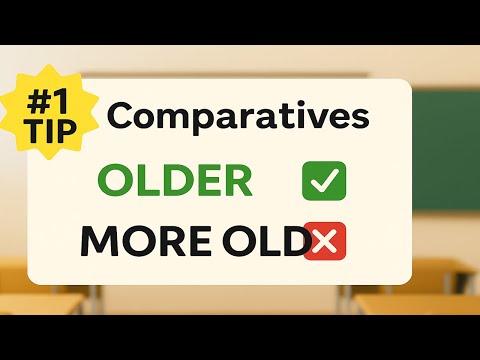
To compare two things in English, add -er to short adjectives and put 'more' before longer ones, then join the comparison with 'than'. Short adjectives take the ending directly, as in "She is taller than me", and when a word ends in a single vowel plus consonant you double that consonant (big becomes bigger). Longer adjectives use 'more' instead, as in "This is more expensive than that" - never both at once, so 'more bigger' is wrong. A few common adjectives are irregular and change their form completely: good becomes 'better' ("My new phone is better"), bad becomes 'worse', and far becomes 'further'.
Examples
- She is taller than me. her height is greater than the speaker's
- This is more expensive than that. this costs more than that
- My new phone is better. the new phone is superior
The full lesson
Everything in the video, in text.
-
Want to compare two things in English? There's one simple rule — and one mistake that gives learners away instantly.
-
Comparing is everywhere — prices, people, choices. The whole system comes down to the length of the adjective: short words and long words behave differently.
-
Here's the split. For short adjectives — one syllable — you add -er to the end: tall becomes taller. For longer adjectives, you keep the word and put more in front.
-
Let's see it in action. Tall is short, so we add -er — and we join the comparison with than. She is taller than me.
-
Expensive is a long word, so it stays whole and takes more in front. Again, than links the two things. This is more expensive than that.
-
One spelling trap with short words. When an adjective ends in a single vowel and consonant, you double that last consonant before -er. Big becomes bigger, not biger.
-
And adjectives ending in -y switch the y to i, then add -er. Happy becomes happier; easy becomes easier. Today is happier than yesterday.
-
Now the must-know exceptions. A few common adjectives are irregular — they don't follow either pattern. Good becomes better, bad becomes worse, and far becomes further.
-
So you never say more good. Good simply becomes better. My new phone is better.
-
Here's the mistake that gives you away. Never use both at once. It's either bigger or more big — never more bigger. Pick one comparison, not two.
-
And don't forget the spelling. With these short words you must double the final consonant — it's bigger and hotter, with two letters, never one.
-
Let's lock it in. Short adjectives add -er; long ones take more; join them with than; and a handful — good, bad, far — are simply irregular.