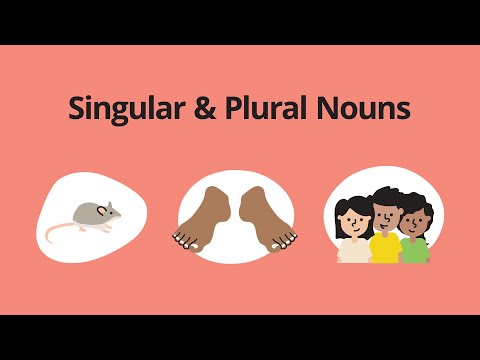
English Plural Nouns: -s, -es, and Common Irregulars
Most English nouns become plural by adding -s, so one book becomes "two books." Add -es when a noun ends in s, x, ch, or sh ("three boxes"), and change a final consonant + y to -ies (city becomes cities). A handful of nouns are irregular and don't take -s at all: man/men, woman/women, foot/feet, and child, which becomes "two children." Watch out for uncountable nouns like information and advice, which never take a plural -s.
Examples
- two books more than one book
- three boxes more than one box
- two children more than one child
The full lesson
Everything in the video, in text.
-
Say two book, and everyone instantly hears that it's wrong. In English, the moment there's more than one thing, the noun itself has to change.
-
The basic rule is wonderfully simple. For most nouns, you just add an -s to the end. One cat becomes two cats, and that single move covers the vast majority of English words.
-
Most everyday nouns work exactly like this. three dogs
-
But if a noun ends in s, x, ch, or sh, adding just -s would be hard to pronounce. So instead we add -es, which gives it an extra syllable. two boxes
-
Same reason here — watch ends in ch. three watches
-
Now a small spelling change. When a noun ends in a consonant followed by -y, that y turns into -ies.
-
So city doesn't become citys. It becomes two cities
-
But watch out for one catch. If a vowel comes before the y, the y stays and you simply add -s. Boy becomes boys, and day becomes days.
-
Finally, a handful of very common nouns ignore every rule. You simply have to memorize them — and they're some of the most-used words in English.
-
Man becomes men. Woman becomes women. Foot becomes feet, and tooth becomes teeth. Notice the vowel sound changes in the middle instead of an ending being added.
-
And the trickiest one of all — it's never childs. One child becomes two children
-
The number-one mistake learners make is forgetting the plural altogether. If there's more than one, the -s is not optional.
-
But don't over-correct either. Some nouns are uncountable and never take a plural -s. It's information, never informations.
-
So, to recap: add -s for most nouns, -es after s, x, ch, and sh, and -ies for a consonant plus y. Then just memorize the few irregulars.