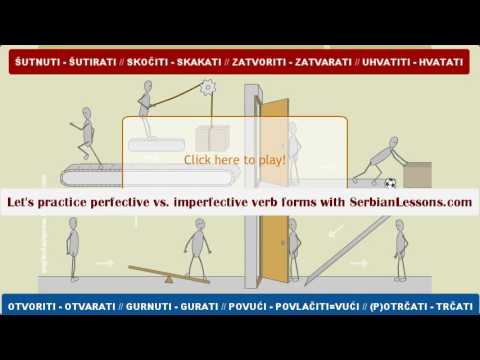
Serbian Verb Aspect: Imperfective vs Perfective
If there is one thing that surprises every English speaker learning Serbian, it is this: most Serbian verbs come in pairs. There is one verb for an action seen as ongoing, repeated, or habitual, and a separate verb for the same action seen as a single, completed whole. These are the two aspects: imperfective and perfective. So "to read" is not one verb but two that you learn together: čitati (imperfective) and pročitati (perfective). Same for "to write" (pisati / napisati), "to do" (raditi / uraditi), and "to learn" (učiti, naučiti). The crucial mindset shift is that these are two different verbs you memorize side by side, not two tenses of one verb. How are the pairs built? Most often by a prefix on the imperfective: čitati becomes pročitati (pro-), pisati becomes napisati (na-), raditi becomes uraditi (u-). Sometimes the relationship runs the other way, through a suffix or infix (dati / davati, with -va-). Because a prefix can also nudge the meaning, the safe habit is to learn each pair from an example rather than to guess a rule. Here is where English is your friend and your trap at the same time. English does not bake "ongoing versus finished" into the verb itself; it shows the contrast with tense and helpers. You say "I am reading" for the ongoing process and "I have read it" or "I read it" for the finished result, but the verb "read" never changes its core. In Serbian, that choice happens earlier, when you pick which verb of the pair to use. "Čitam knjigu." means you are in the middle of it; "Pročitao sam knjigu." means the book is done. That leads to the single biggest trap: a perfective verb has no present-progressive meaning. You cannot use the perfective to say what is happening right now. For "I am reading the book now" you must reach for the imperfective, "Čitam knjigu." A perfective in the present tense points to the future or lives inside a subordinate clause (napišem, naučim). Let the meaning, not habit, choose the aspect. Repeated or habitual action takes the imperfective: "Svaki dan učim srpski." A single finished event takes the perfective: "Naučio sam pesmu." And do not default to the imperfective in the past just because it feels softer, if the action is genuinely complete, use the perfective. The two often meet in one sentence, an ongoing background plus a sudden event: "Dok sam jeo, telefon je zazvonio." A quick test built for English speakers: if "for two hours" fits the idea, you want the imperfective (the process); if "in two hours" or "finished" fits, you want the perfective (the result).
Examples
- pisati / napisati to write / to write (finish)
- Čitam knjigu. I'm reading a book.
- Pročitao sam knjigu. I've read the book (finished it).
The full lesson
Everything in the video, in text.
-
Čitam knjigu — and I never finish it. Pročitam knjigu — and it's done. The same action, yet two completely different verbs. That's verb aspect, and it's the single biggest leap in all of Serbian. Let's clear it up for good.
-
Here's the heart of it. Almost every Serbian verb comes as a pair. One is imperfective — an action that is ongoing, repeated, or general. The other is perfective — an action seen as one whole, completed unit. They are two different words you learn together, as a pair.
-
Don't confuse this with tense. Serbian carries the ongoing versus done difference inside the word itself — in the aspect, not in the tense. Imperfective: pisati, čitati, raditi. Perfective: napisati, pročitati, uraditi. Often they differ only by a prefix, but they are two verbs.
-
Let's start with the imperfective, with an action in progress. What are you doing right now? You're reading a book, right in the middle of it: Čitam knjigu. I'm reading a book. The verb čitam is imperfective — it pictures an action that flows, and says nothing about whether you'll finish it. What matters is the process itself.
-
And now the perfective aspect — the same action, but as a completed whole. You've read the book, you reached the end: Pročitao sam knjigu. I've read the book. Pročitao sam is perfective — it stresses the result, that the book is now finished. The prefix pro- turns čitati into pročitati: an action that is closed.
-
Look at the same pair in action once more, with writing. While pišem pismo, the action is ongoing, imperfective: Pišem pismo. I'm writing a letter. And when I finish it, I switch to the perfective — napisati: Napisao sam pismo. I wrote the letter. The same pair: pisati for the process, napisati for the result.
-
How is the pair formed? Most often in two ways. First, with a prefix: pisati gives napisati, čitati gives pročitati, raditi gives uraditi or odraditi. The prefix closes the action. Second, with a suffix in the middle of the word: dati is perfective, davati imperfective. Both ways are all around you.
-
Aspect also changes what the tense means. The imperfective describes a habit or repetition. You say you study Serbian every day — an action that keeps coming back: Svaki dan učim srpski. I study Serbian every day. Učim is imperfective, so it perfectly captures a habit that goes on day after day.
-
The perfective aspect, on the other hand, captures a single, one-off event — once and done. You learned the poem, all the way through, as a closed result: Naučio sam pesmu. I learned the poem. Naučio sam is perfective: not a habit but one finished act. Učim is the process, naučim is the outcome.
-
And now the main trap — the reason you're here. A perfective verb has no true present tense for an action in progress. Pročitam knjigu does not mean I'm reading it right now. For what's happening now you always need the imperfective: čitam. The perfective present looks to the future or to a condition.
-
And the other side of the same coin. When the action is clearly finished, don't pick the imperfective just because it's more familiar to you. Juče sam čitao knjigu sounds unfinished; if you read it to the end, you say pročitao sam. Let the aspect carry the done.
-
Let's join both aspects in one sentence, so you feel the contrast. While the action was flowing — imperfective; the moment it was completed — perfective: Dok sam jeo, telefon je zazvonio. While I was eating, the phone rang. Jeo sam is the ongoing background, imperfective; zazvonio je is one sudden, perfective event. Aspect paints the whole scene.
-
Let's sum up. Almost every verb has a pair: the imperfective for an action that goes on, repeats, or is a habit — čitam; and the perfective for one completed whole — pročitam. They are two verbs, not two tenses. For what's happening now, choose the imperfective. Learn the pair together, and aspect will become natural to you.